Serial Communication
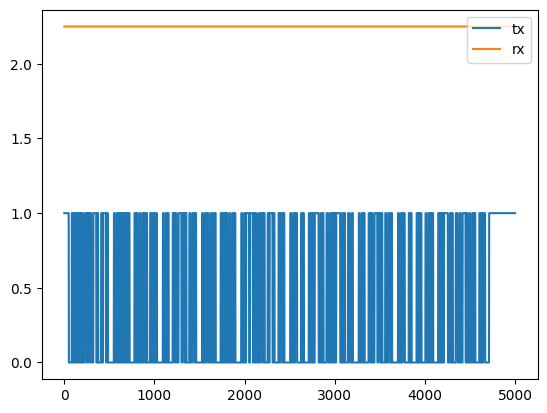
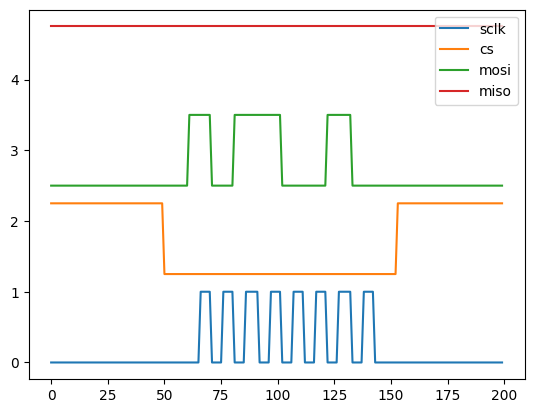
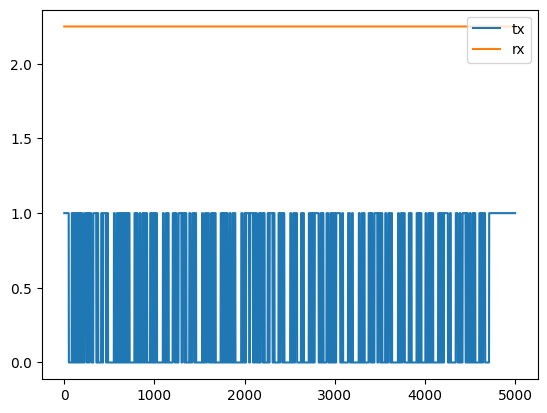
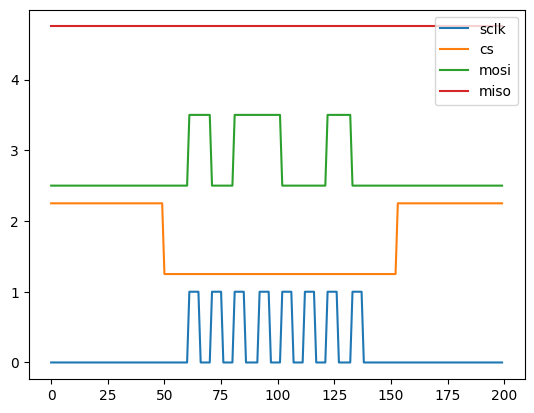
This example shows how to set up digital_io_2[0-3] and digital_io_3[0-3] as SPI master and UART transmitter, respectively. The internal scopes are used to monitor both interfaces.
In detail, 4 IO Sync Frames are implemented to showcase the different CPOL and CPHA settings of the SPI interface. The UART interface is used to print log messages and can be read by connecting a USB to UART bridge (FT232) to the corresponding TX and RX lines. See README for IO Names and Pin Mapping.
Imports
import time
import numpy as np
from matplotlib import pyplot as plt
from openlabctrl.device import Rp_125_14_Z7010
from openlabctrl.sequence import IoSequence
from openlabctrl.frame import IoSyncFrame
from openlabctrl.io.scope import ScopeSource
from openlabctrl.serial.spi import SPI
from openlabctrl.serial.uart import UART
Device instances
rp_0 = Rp_125_14_Z7010(ip="192.168.1.143", label="rp_0")
IO Sequences & IO Frames instances
seq = IoSequence(device_list=[rp_0])
fr_0 = IoSyncFrame(device_type=Rp_125_14_Z7010, trig=None)
fr_1 = IoSyncFrame(device_type=Rp_125_14_Z7010, trig=None)
fr_2 = IoSyncFrame(device_type=Rp_125_14_Z7010, trig=None)
fr_3 = IoSyncFrame(device_type=Rp_125_14_Z7010, trig=None)
Frame definitions
#FRAME 0-3 write UART & SPI (cpha=0-1, cpol=0-1)
for fr, cpol, cpha in zip([fr_0, fr_1, fr_2, fr_3], [0, 0, 1, 1], [0, 1, 0, 1]):

    #SPI @ digital_io_2[0-4] and sclk of 122.07kHz
    #Using defaults for sclk_mask= 0b0001, cs_mask= 0b0010, mosi_mask= 0b0100, miso_mask= 0b1000
    spi = SPI(io = fr.digital_io_2, clk_div=1024, cpol=cpol, cpha=cpha)

    #UART @ digital_io_3[0-1] and baudrate of 115200
    #Using defaults for data_len=8, stop_len=1, parity=None, tx_mask= 0b0001, rx_mask= 0b0010
    uart = UART(io = fr.digital_io_3, baud=115200)

    fr.reset()
    spi.io_config()
    fr.scope_0.source(ScopeSource.DIGITAL_IO_2)
    fr.scope_0.decimation(100)
    fr.scope_1.source(ScopeSource.DIGITAL_IO_3)
    fr.scope_1.decimation(100)
    fr.rsync()

    fr.scope_0.acquire(200, label="SPI")
    fr.scope_1.acquire(5000, label="UART")
    fr.delay(5000)
    uart.write(data=f"Test UART and SPI with CPOL={cpol} and CPHA={cpha}.\n\r")
    spi.cs_low()
    spi.write(data=0b10110010, size=8)
    spi.cs_high()
Sequence definition
seq.reset()
for fr, cpol, cpha in zip([fr_0, fr_1, fr_2, fr_3], [0, 0, 1, 1], [0, 1, 0, 1]):
    seq.add_frame(frame=fr, device=rp_0, label=f"UART & SPI (cpol={cpol} cpha={cpha})")

print(seq.sequence_description())
+----------------------------+
| rp_0@192.168.1.143         |
+----------------------------+
| UART & SPI (cpol=0 cpha=0) |
| UART & SPI (cpol=0 cpha=1) |
| UART & SPI (cpol=1 cpha=0) |
| UART & SPI (cpol=1 cpha=1) |
+----------------------------+
NOTE: Frames with (*) are triggered by external trigger source.
Upload & Run sequence
seq.upload()
seq.start()
while not seq.is_done():
    if seq.is_error():
        print("Sequence error. Please check status.")
        break
    time.sleep(0.01)
seq.get_status()
{'rp_0@192.168.1.143': {'enabled': True,
  'done': True,
  'error': False,
  'current_frame': 'UART & SPI (cpol=1 cpha=1)',
  'io': {'rf_out_0': {'error': False, 'done': True},
   'rf_out_1': {'error': False, 'done': True},
   'digital_io_0': {'error': False, 'done': True},
   'digital_io_1': {'error': False, 'done': True},
   'digital_io_2': {'error': False, 'done': True},
   'digital_io_3': {'error': False, 'done': True},
   'analog_out_0': {'error': False, 'done': True},
   'analog_out_1': {'error': False, 'done': True},
   'analog_out_2': {'error': False, 'done': True},
   'analog_out_3': {'error': False, 'done': True},
   'scope_0': {'error': False, 'done': True},
   'scope_1': {'error': False, 'done': True},
   'led': {'error': False, 'done': True}}}}
# seq.stop()
Plot acquisitions
scope_dict = seq.get_scope()

for device_id in scope_dict.keys():
    for frame_label in scope_dict[device_id].keys():
        for scope_label in scope_dict[device_id][frame_label].keys():
            for acq_label in scope_dict[device_id][frame_label][scope_label].keys():
                t = scope_dict[device_id][frame_label][scope_label][acq_label]["t"]
                dec = scope_dict[device_id][frame_label][scope_label][acq_label]["dec"]
                samples = scope_dict[device_id][frame_label][scope_label][acq_label]["samples"]
                src = scope_dict[device_id][frame_label][scope_label][acq_label]["src"]
                data = scope_dict[device_id][frame_label][scope_label][acq_label]["data"]
                print(f"Device: {device_id}")
                print(f"Frame: {frame_label}")
                print(f"Scope: {scope_label}")
                print(f"Label: {acq_label}")
                print(f"Time: {t}")
                print(f"Decimation: {dec}")
                print(f"Samples: {samples}")
                print(f"Source: {src}")
                if "SPI" in acq_label:
                    plt.figure()
                    plt.plot(np.bitwise_and(np.right_shift(data, 0), 1), label="sclk")
                    plt.plot(1.25 + np.bitwise_and(np.right_shift(data, 1), 1), label="cs")
                    plt.plot(2.5 + np.bitwise_and(np.right_shift(data, 2), 1), label="mosi")
                    plt.plot(3.75 + np.bitwise_and(np.right_shift(data, 3), 1), label="miso")
                    plt.legend(loc=1)
                    plt.show()
                elif "UART" in acq_label:
                    plt.figure()
                    plt.plot(np.bitwise_and(np.right_shift(data, 0), 1), label="tx")
                    plt.plot(1.25 + np.bitwise_and(np.right_shift(data, 1), 1), label="rx")
                    plt.legend(loc=1)
                    plt.show()
Device: rp_0@192.168.1.143
Frame: UART & SPI (cpol=0 cpha=0)
Scope: scope_0
Label: SPI
Time: 2
Decimation: 100
Samples: 200
Source: DIGITAL_IO_2
Device: rp_0@192.168.1.143
Frame: UART & SPI (cpol=0 cpha=0)
Scope: scope_1
Label: UART
Time: 2
Decimation: 100
Samples: 5000
Source: DIGITAL_IO_3
Device: rp_0@192.168.1.143
Frame: UART & SPI (cpol=0 cpha=1)
Scope: scope_0
Label: SPI
Time: 2
Decimation: 100
Samples: 200
Source: DIGITAL_IO_2
Device: rp_0@192.168.1.143
Frame: UART & SPI (cpol=0 cpha=1)
Scope: scope_1
Label: UART
Time: 2
Decimation: 100
Samples: 5000
Source: DIGITAL_IO_3
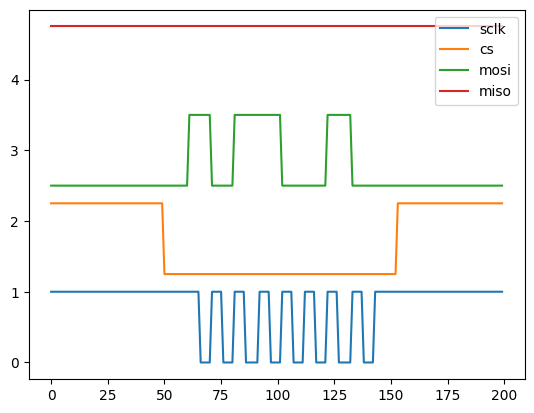
Device: rp_0@192.168.1.143
Frame: UART & SPI (cpol=1 cpha=0)
Scope: scope_0
Label: SPI
Time: 2
Decimation: 100
Samples: 200
Source: DIGITAL_IO_2
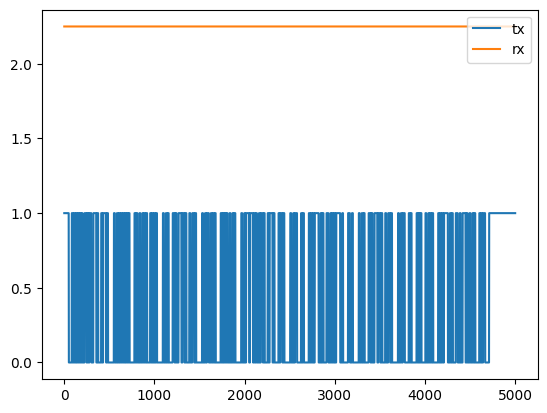
Device: rp_0@192.168.1.143
Frame: UART & SPI (cpol=1 cpha=0)
Scope: scope_1
Label: UART
Time: 2
Decimation: 100
Samples: 5000
Source: DIGITAL_IO_3
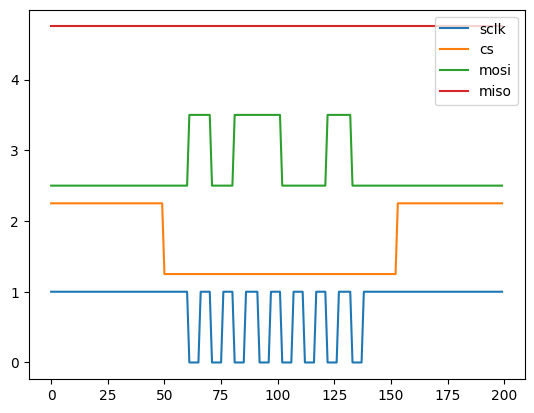
Device: rp_0@192.168.1.143
Frame: UART & SPI (cpol=1 cpha=1)
Scope: scope_0
Label: SPI
Time: 2
Decimation: 100
Samples: 200
Source: DIGITAL_IO_2
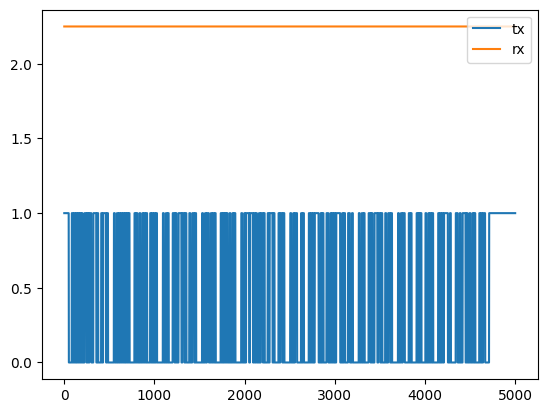
Device: rp_0@192.168.1.143
Frame: UART & SPI (cpol=1 cpha=1)
Scope: scope_1
Label: UART
Time: 2
Decimation: 100
Samples: 5000
Source: DIGITAL_IO_3