Digital IO
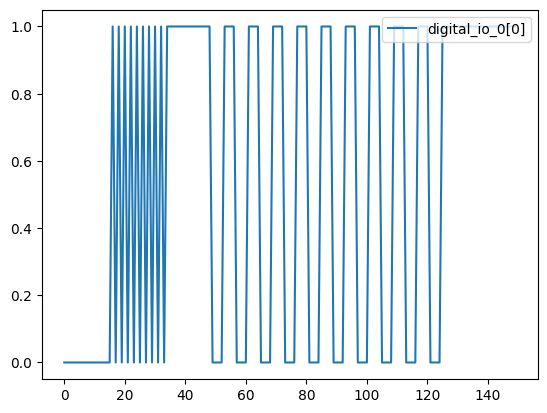
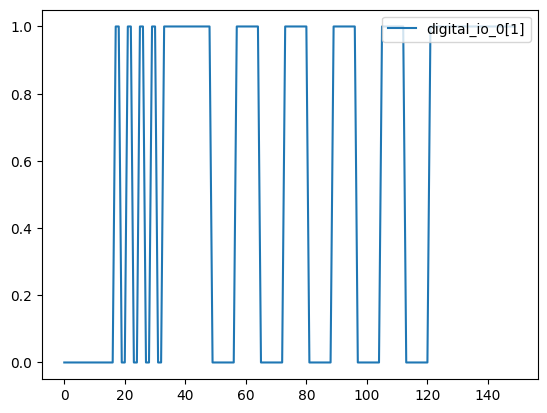
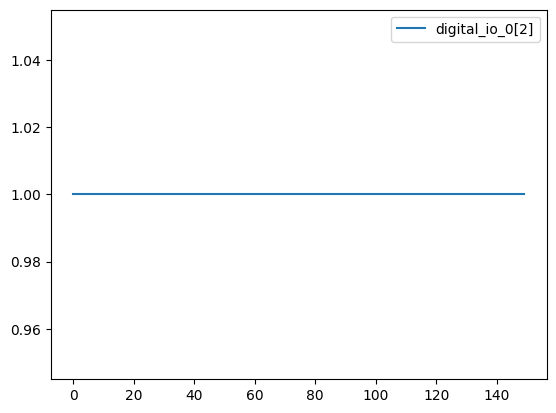
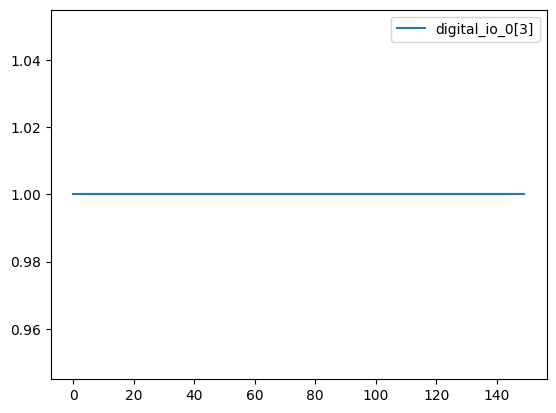
This example demonstrates how to control the direction of the digital IOs (in/out) and set their values creating square waves with periods of 2, 4, 8 and 16 clk cycles. The digital IO values are monitored via the internal scope (acquisition) logic. See README for IO Names and Pin Mapping.
Imports
import time
import numpy as np
from matplotlib import pyplot as plt
from openlabctrl.device import Rp_125_14_Z7010
from openlabctrl.sequence import IoSequence
from openlabctrl.frame import IoSyncFrame
from openlabctrl.io.scope import ScopeSource
Device instances
rp_0 = Rp_125_14_Z7010(ip="192.168.1.143", label="rp_0")
IO Sequences & IO Frames instances
seq = IoSequence(device_list=[rp_0])
fr_0 = IoSyncFrame(device_type=Rp_125_14_Z7010, trig=None)
fr_1 = IoSyncFrame(device_type=Rp_125_14_Z7010, trig=None)
fr_2 = IoSyncFrame(device_type=Rp_125_14_Z7010, trig=None)
Frame definitions
#FRAME 0
#Configure acquisition
fr_0.reset()
fr_0.scope_0.source(ScopeSource.DIGITAL_IO_0)
fr_0.scope_0.decimation(1)
fr_0.scope_0.acquire(samples=150, label="acq_0", run_async=True)

#Set direction of digital IOs
# Digital_IO_0[3] : input
# Digital_IO_0[2] : input
# Digital_IO_0[1] : output
# Digital_IO_0[0] : output
fr_0.digital_io_0.tristate(val=0b1100, mask=0b1111)

#Set initial value of outputs (inputs are driven high by internal pull-up resistors, so they read 1 if not connected)
fr_0.digital_io_0.output(0b0000, mask=0b0011)


#FRAME 1
fr_1.reset()
#Square wave with 2 and 4 clk cycles period on DIGITAL_IO_0[0] and DIGITAL_IO_0[1]
fr_1.set_time_increment(1) #Default time increment
for i in range(5):
    fr_1.digital_io_0.output(val=0b0000, mask=0b0011)
    fr_1.digital_io_0.output(val=0b0001, mask=0b0011)
    fr_1.digital_io_0.output(val=0b0010, mask=0b0011)
    fr_1.digital_io_0.output(val=0b0011, mask=0b0011)


#FRAME 2
fr_2.reset()
#Square wave with 8 and 16 clk cycles period on DIGITAL_IO_0[0] and DIGITAL_IO_0[1]
fr_2.set_time_increment(4)
for i in range(5):
    fr_2.digital_io_0.output(val=0b0000, mask=0b0011)
    fr_2.digital_io_0.output(val=0b0001, mask=0b0011)
    fr_2.digital_io_0.output(val=0b0010, mask=0b0011)
    fr_2.digital_io_0.output(val=0b0011, mask=0b0011)
Sequence definition
seq.reset()
seq.add_frame(frame=fr_0, device=rp_0, label="Acq & IO config")
seq.add_frame(frame=fr_1, device=rp_0, label="Square wave. Period: 2, 4 clk cycles")
seq.add_frame(frame=fr_2, device=rp_0, label="Square wave. Period: 8, 16 clk cycles")

print(seq.sequence_description())
+---------------------------------------+
| rp_0@192.168.1.143                    |
+---------------------------------------+
| Acq & IO config                       |
| Square wave. Period: 2, 4 clk cycles  |
| Square wave. Period: 8, 16 clk cycles |
+---------------------------------------+
NOTE: Frames with (*) are triggered by external trigger source.
Upload & Run sequence
seq.upload()
seq.start()
while not seq.is_done():
    if seq.is_error():
        print("Sequence error. Please check status.")
        break
    time.sleep(0.01)
seq.get_status()
{'rp_0@192.168.1.143': {'enabled': True,
  'done': True,
  'error': False,
  'current_frame': 'Square wave. Period: 8, 16 clk cycles',
  'io': {'rf_out_0': {'error': False, 'done': True},
   'rf_out_1': {'error': False, 'done': True},
   'digital_io_0': {'error': False, 'done': True},
   'digital_io_1': {'error': False, 'done': True},
   'digital_io_2': {'error': False, 'done': True},
   'digital_io_3': {'error': False, 'done': True},
   'analog_out_0': {'error': False, 'done': True},
   'analog_out_1': {'error': False, 'done': True},
   'analog_out_2': {'error': False, 'done': True},
   'analog_out_3': {'error': False, 'done': True},
   'scope_0': {'error': False, 'done': True},
   'scope_1': {'error': False, 'done': True},
   'led': {'error': False, 'done': True}}}}
seq.stop()
Plot acquisitions
scope_dict = seq.get_scope()

for device_id in scope_dict.keys():
    for frame_label in scope_dict[device_id].keys():
        for scope_label in scope_dict[device_id][frame_label].keys():
            for acq_label in scope_dict[device_id][frame_label][scope_label].keys():
                t = scope_dict[device_id][frame_label][scope_label][acq_label]["t"]
                dec = scope_dict[device_id][frame_label][scope_label][acq_label]["dec"]
                samples = scope_dict[device_id][frame_label][scope_label][acq_label]["samples"]
                src = scope_dict[device_id][frame_label][scope_label][acq_label]["src"]
                data = scope_dict[device_id][frame_label][scope_label][acq_label]["data"]
                print(f"Device: {device_id}")
                print(f"Frame: {frame_label}")
                print(f"Scope: {scope_label}")
                print(f"Label: {acq_label}")
                print(f"Time: {t}")
                print(f"Decimation: {dec}")
                print(f"Samples: {samples}")
                print(f"Source: {src}")

                for i in range(4):
                    plt.figure()
                    plt.plot(((data >> i ) & 1), label= f"digital_io_0[{i}]")
                    plt.legend(loc=1)
                    plt.show()
Device: rp_0@192.168.1.143
Frame: Acq & IO config
Scope: scope_0
Label: acq_0
Time: 2
Decimation: 1
Samples: 150
Source: DIGITAL_IO_0